Ask a principal how long report cards take at the end of a term and the honest answer is rarely "an afternoon." It is closer to a week - a week where a handful of teachers stop doing much else, chase marks from colleagues, wrestle with Excel formulas, retype remarks, reformat layouts, and then fix the errors that slip through anyway. Nobody planned for it to eat a week. It just does, every single term, because the work is spread across so many small manual steps that no one ever adds them up. This post walks through exactly where that week goes, step by step, and then how schools cut the same job down to hours.
Step 1: Collecting the Marks (Day 1 to 2)
The week does not start with calculation. It starts with collection - getting every subject teacher to hand in complete, correct marks for every student.
In most schools this happens over WhatsApp, printed mark sheets, or a shared drive with a dozen slightly different Excel files. One teacher submits late. Another sends a file with two students missing. A third used a different column order than everyone else. The exam coordinator spends the first two days not calculating anything, just assembling a complete set of numbers and sending reminders to the teachers who have not submitted yet.
This stage is invisible in most estimates of "how long report cards take," but it is often the single biggest chunk of the week. You cannot compute a total until every subject is in, and getting every subject in from every teacher is a coordination problem, not a math problem.
Step 2: Totals, Grades, and Ranks by Hand (Day 2 to 3)
Once the marks are gathered, the arithmetic begins. For each student, someone adds subject marks into a total, converts each total into a grade, applies the grade point, and then sorts the whole class to assign ranks.
In Nepal this is where the NEB grading scale bites. A generic percentage template does not produce an A+ to NG grade or a GPA without someone building the conversion formula by hand, class by class, and hoping the cell references do not drift when a row is inserted. One misaligned VLOOKUP and an entire section gets the wrong grade - and no one notices until a parent does.
Ranking makes it worse. Ranks depend on every student in the class, so a single corrected mark means re-sorting and re-numbering the whole section. Do that across fifteen sections and the "quick fix" from Step 5 quietly sends you back to Step 2.
The hidden multiplier here is corrections. A school does not do this arithmetic once - it does it, finds an error, fixes it, and redoes every downstream number that depended on the fixed one. Totals feed grades, grades feed GPA, and marks feed ranks. In a manual spreadsheet, one late correction can ripple through hundreds of cells, and there is no way to be sure you caught them all.
Step 3: Typing Remarks and Assembling Each Card (Day 3 to 4)
Now the numbers exist, but a report card is not just numbers. Class teachers write a remark for every student, the attendance figure gets pulled in from a separate register, and each of these has to land in the right place on the right student's card.
Typing 300 or 400 individual remarks is slow on its own. Copying attendance totals from the attendance register into the report template - by hand, student by student - is where transcription errors creep in: a percentage typed against the wrong name, an attendance figure that does not match the register anyone can check. Every one of these is a small task, and there are hundreds of them.
Step 4: Formatting and Printing (Day 4 to 5)
With content assembled, the layout fight begins. A report card that looks clean for one student breaks when the next student has a longer name, an extra subject, or a remark that runs two lines. Someone nudges margins, resizes columns, and re-checks page breaks so that no card prints half on one page and half on the next.
Then it prints - and printing 400 double-sided cards on a school printer is its own afternoon, complete with the jam that happens at card number 280 and the reprint of the batch that came out with a faded logo.
Step 5: Finding and Fixing the Errors (Day 5 and Beyond)
No manual process this long is error-free, so the last stage is catching mistakes before parents do - and catching the rest after they do.
A grade that does not match the total. A rank that skips a number. An attendance figure copied to the wrong child. Each fix is quick in isolation, but as Step 2 showed, a corrected mark can force a re-rank and a reprint. This is why report card season so often bleeds past the deadline: the school is not finishing the work, it is finishing the corrections to the work.
Where the Week Actually Went
Laid out end to end, the week is not one hard task. It is a chain of manual handoffs, each cheap on its own and expensive in aggregate:
The teachers are not slow. The process is. The same numbers get touched five or six times by different people, and nothing is connected, so nothing carries forward.
How Schools Cut It to Hours
The fix is not "work faster." It is to stop doing the parts that a system should do once and reuse. When marks live in the same system that already holds attendance and student records, the chain above collapses:
- Collection becomes entry. Each subject teacher enters marks directly against the student record. The coordinator sees at a glance which subjects are still missing, so Day 1 and 2 become a status screen, not a treasure hunt.
- Calculation becomes automatic. Totals, NEB grades, GPA, and ranks compute the moment marks are complete - and re-compute instantly when a mark is corrected, so a fix never means re-ranking a class by hand. This is the heart of a proper school exam management system.
- Remarks and attendance flow in. Attendance is already in the system, so it appears on the card with no retyping. Teachers write remarks in the same place, once.
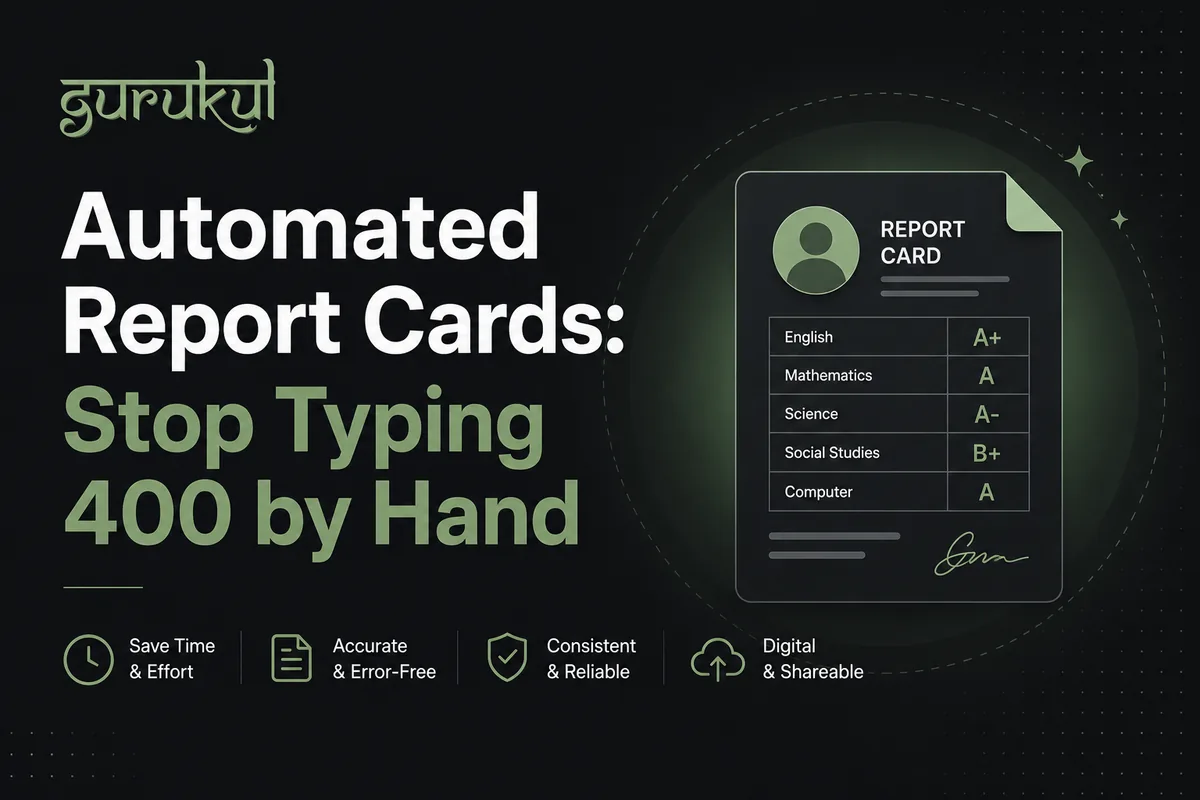
- Formatting is a template, not a fight. One card design handles every student, long names and extra subjects included, and the whole school generates as PDFs in seconds rather than being laid out one by one. That is the shift covered in automated report cards.
- Publishing skips the printer entirely. Cards go straight to parents in the portal, and for board results the same approach applies to publishing SEE results online without a manual scramble.
None of this removes the teacher's judgment - the remark and the mark are still theirs. It removes the retyping, the re-sorting, and the reprinting that turned that judgment into a week of clerical work.
The realistic outcome is not magic. It is a term-end that takes an afternoon of mark entry and a few minutes of generation instead of a week of assembly. The teachers get the week back, the parents get results sooner, and the numbers on the card actually match the numbers in the register - because they came from the same place.
Gurukul turns term-end from a week into an afternoon: marks entered once, NEB grades and ranks calculated automatically, and every report card generated and delivered to parents in one step. See the platform or book a free demo.