A software demo is a sales tour, not an audit. The rep chooses what to show, in what order, and moves quickly past the parts where the product is weaker. That is not dishonest - it is how demos work everywhere - but it means the burden of finding the gaps is on you. The good news is that the gaps are predictable, and a school can surface almost all of them with a fixed list of pointed questions asked live, on screen, in front of the vendor. This is that list: twelve specific questions to bring to every demo, in the same order, for every vendor. It is deliberately not a repeat of the criteria for choosing school management software - that post is about what to value. This is the script you actually read out loud on the call.
1. Show Me the BS Calendar Live, Not on a Slide
Ask the vendor to generate a report card and an attendance report with Bikram Sambat dates, right now, on screen. Not a mockup, not "it's in the settings." Your academic year, terms, and reports all run on BS, and a system that stores Gregorian dates and converts them for display is a different thing from one that only prints a converted date on a PDF. If the answer involves switching to a "beta module" or converting dates by hand, that is your answer.
2. Walk Me From Khalti Payment to Receipt
Do not accept "we support online payments." Name the gateways your parents actually use - eSewa, Khalti, Fonepay - and ask the vendor to walk through what happens from the moment a parent pays to the moment the receipt appears against that student's record. If reconciliation is still manual, your accountant does the matching by hand regardless of the "integration."
3. What Happens When the Internet Drops Mid-Attendance?
Connectivity is unreliable in much of Nepal outside the Valley - headline penetration figures run above 100 percent because people hold multiple SIM-based connections, but the gap between coverage on paper and usable access at home is where your school actually lives. Ask exactly what happens if a teacher is halfway through marking attendance and the connection dies. Does the work survive and sync later, or is it lost? A system that freezes or discards data during an outage is worse than the paper register it replaced.
4. Generate an NEB Report Card With Mixed Grades
Ask for a sample report card using the NEB A+ to NG scale and GPA, for a student with a spread of grades - not a clean all-A student who hides rounding problems. The letter-grading system Nepal moved to has specific boundaries and a non-graded band, and generic percentage engines get the edges wrong. Generic percentage systems that someone reformats into NEB grades by hand are common, and this question exposes them in about thirty seconds.
5. If We Left in Six Months, What Do We Get Back?
Your student records, fee history, and marks are yours. Ask what file format you would receive your data in if you left, and how long it would take. "You can export to Excel" is not enough - ask to see the actual export, because a format your own accountant cannot open without vendor help is lock-in with extra steps.
Questions 5 and 12 - data export and exit terms - are the two most likely to make a rep uncomfortable, and the two most worth asking. A vendor confident in keeping you by being good is comfortable telling you how to leave. A vendor that keeps you by making leaving hard will get vague here. Their comfort with the exit question tells you how they plan to earn the relationship.
6. What Exactly Do You Migrate, and What Do We Retype?
Every vendor says migration is easy. Make them define easy in specifics. What do they import for you - student names, classes, historical fee ledgers - and what does your staff re-enter by hand? The honest answer is that names and sections import quickly, fee history takes work, and old marks are usually re-keyed. A vendor promising instant, complete, zero-effort migration is describing something that rarely survives contact with a real school's messy spreadsheets.
7. Give Me the Total Cost in Writing, for Our Exact Student Count
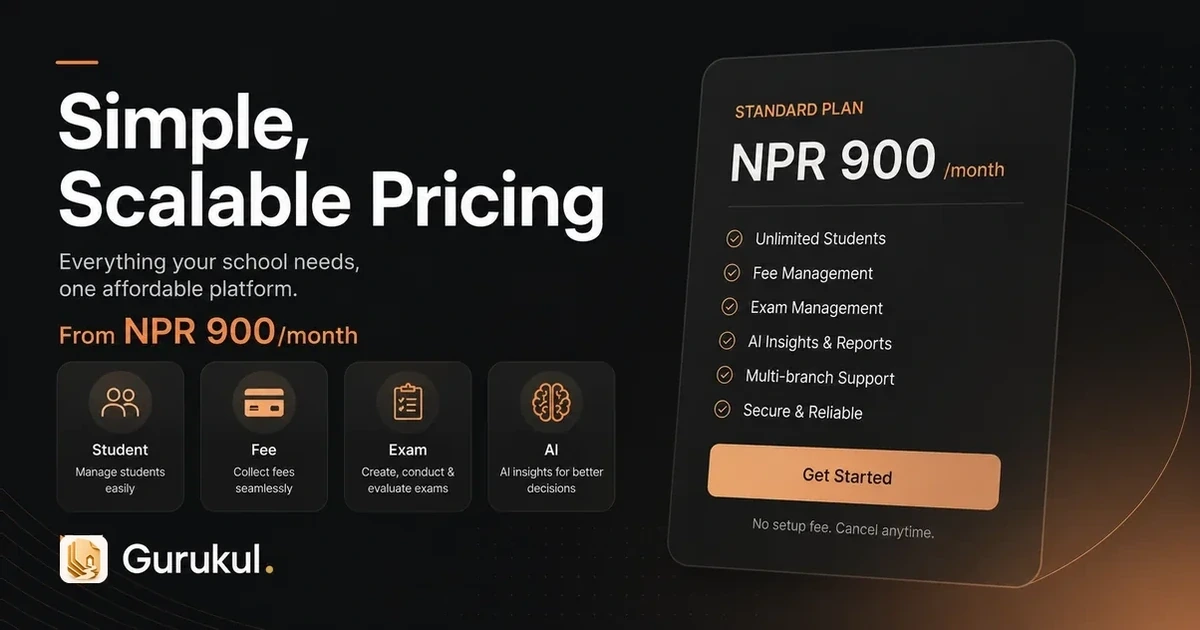
Get every number, not the headline. Per-student rate, setup fees, "customization" charges, training, SMS costs, support tiers, and what the price becomes at renewal. Padded costs hide in the line items that never make it into the demo, and per-student pricing in particular varies enormously between vendors even in published international benchmarks - which is exactly why a headline rate tells you almost nothing on its own. A detailed breakdown of what school software actually costs in Nepal is worth reading first so you know which charges are normal and which are padding.
8. What Is Your Actual Support Response Time, in Nepali?
When a report card will not generate the night before distribution, you need an answer in hours, not a ticket number. Ask for the real average response time, not the marketing SLA, and confirm support can communicate in Nepali if your staff need that. Ask what support looks like during exam season specifically, when everyone needs help at once.
9. Show Me Three Logins: Teacher, Accountant, Parent
Fee data, exam marks, and student records need different access for different people. Ask the vendor to log in as a teacher, then an accountant, then a parent, and show what each can and cannot see. If the answer is one shared login or vague "role settings," that is a security and privacy liability, not a configuration detail.
10. Who in This Demo Actually Uses the Product Daily?
A polished dashboard demoed by a sales engineer tells you the product photographs well. Ask to see the specific daily workflow your staff will run - the accountant's fee-collection screen, the teacher's mark-entry screen - operated at real speed, ideally by your own staff on the call. Better still, ask for a short pilot with one class before committing the whole school. Resistance to a pilot is usually resistance to scrutiny.
11. Which of These Features Is Live Today Versus "Coming Soon"?
Go down the feature list and ask, bluntly, which items are live right now and which are on the roadmap. "Coming in the next update" is the single most expensive phrase in a demo, because roadmaps slip and your exam season will not wait. If a feature you need - BS calendar, a specific gateway, NEB grading - is not live today, treat it as absent, not promised.
12. If This Does Not Work Out in Three Months, What Does Leaving Cost?
Read the contract question out loud. Is there a one-year lock-in? An early-exit clause? What happens to your data if you stop paying? Vendor lock-in in subscription software is rarely a single clause you can point at - it is the accumulated cost of proprietary formats and configuration that does not travel, which is why the question has to be asked before you sign rather than discovered when you want to leave. A mid-year switch during exam season is a serious disruption, so knowing the exit cost before you sign is not pessimism - it is due diligence. Pair this with the data-export answer from question 5 to see the full picture of how stuck you would be.
How to Actually Run the Call
The questions only work if you use them the same way every time:
- Bring the same twelve to every vendor, in the same order. This is what makes demos comparable instead of a blur of confident pitches.
- Write the answers down in front of the vendor. It keeps you from being swept along, and it signals a real evaluation, which tends to produce more honest answers.
- Use your own data, not their sample data. Ask them to enter one real fee structure or one real student, siblings and mid-year transfers included. Sample data is always clean; your data has the edge cases.
- Score each answer 0 to 3. Zero if they cannot demonstrate it, three if it is a genuine strength. A vendor with consistent twos and threes across all twelve is in a different category from one strong on the first five and vague after.
These questions are the demo-day companion to a longer evaluation - if any of them landed because your current setup is already straining, the signs a school has outgrown spreadsheets are worth a read before you book demos at all.
Twenty minutes with this script before your next call is cheaper than a school year spent working around software that almost fits. When you are ready, run it against a real product on a free demo, and check the numbers first on the published pricing page - a vendor should let you work out your own cost before the call, not after.
Gurukul answers every one of these twelve questions on screen, not from a slide: BS calendar, eSewa and Khalti reconciliation, NEB report cards, and your data export shown live. See the platform or book a free demo.